
AI in My Art - a Retrospective

I use ai as a subject of my art, but the creation process is entirely human. I think, I plan, I draw my ideas on paper before stretching any burlap, but I have been using the alien technology of ai as my muse. I say alien - not as a spoof - for it truly is alien to us, and I don't think that it is necessarily going to be helpful for humanity. In working on ai themes, some specific ideas have emerged; I have investigated ethics, animation, power and math, sustainability, and human/robot interface. Here are some reflections from my ideas about ai so far and some introspection on how I have developed these ideas in my work. Ethics
Ethics is the most important aspect of artificial intelligence because it has none. It knows no right or wrong. It is biased, racist, conniving, and convincingly wrong about many things, and Ai cannot can't go on a 'gut feeling'. In short, it is not to be trusted or even considered as we would consider other humans. Because all human ideas have only ever been from an embodied perspective, what might ai reasoning look like and how can it be so fallacious?

I explored ethics both in my rug Fuzzy Logic, and through an AI and Ethics course offered through UBC in 2024. I studied the mechanics of decisions and how different concepts can influence outcomes. Course work saw the mapping of these decisions from their root sources to observing how they play out in real life. Frankly, my eyes were opened to revelations of our collective knowledge that were unflattering. Ironically, construction of Fuzzy Logic presented it's own bias that I talk about in another blog post. This happy accident revealed to me my propensity for mistakes, and my own human sense. Consideration revealed to me how and why I discriminate - intentional, or ingrained. This provided me with an opportunity to consider my own upbringing and privilege, and how that manifests. This act of reflection and rumination affected me in ways that opened my eyes, and prompted me to unbar more understanding and compassion, resulting in a softer, more sensitive me.
Regarding the biased and prejudiced popular large language word generators like chatGPT - I saw that they did not reflect on what they were doing and definitely did not manifest improved ideals. How could they when we humans can't even agree on morality? What principles you hold are likely different than others. Perhaps we need to better define ethics for ourselves. Moreover - maybe we need to proffer these types of ideas into the world (and especially on the internet) before hoping that this collective robot progeny will spontaneously emerge knowing right and wrong.
Animation

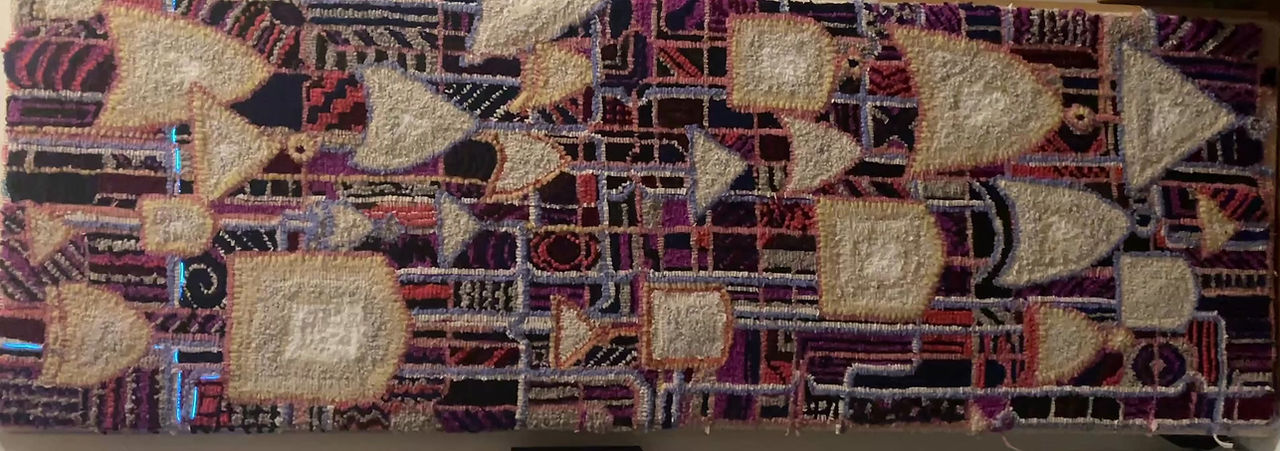
How can ai seem alive? And what makes it work, and what is actually 'under the hood'? In exploring these source questions, I fell into the realm of computer science. Attempting to start at the beginning, I moved beyond the noble perceptron (depicted in Fuzzy Logic), to trying to show how a decision can actually be physically made by a computer. In my attempts, I found the transistor - that award winning little switch that can essentially choose yes, no, and/or any combination of those (AND, NAND, OR, NOR, XOR, XNOR).
Creating and tracking paths of these decisions/bursts of electrical current promoted an investigation into 1s and 0s and how they can be manipulated by being on or off. I wanted to somehow denote this, so I integrated lights into my rug "Logic Gates". These try to eschew the binary nature of power switching decisions while also bringing a little life to the inanimate.
Sustainability
I like the lights in Logic Gates, and I think they are really cool, but I am torn in using materials that are non-natural. Although seamlessly integrated and almost invisible, I know they are there. They are made of plastic, and will never disintegrate, unlike the rest of the rug. Up until this point, all of my work, from materials acquisition to ultimate destruction is centred on a cradle to cradle philosophy. I am proud that I bike to collect used wool and burlap and even deliver works to museums if possible! Everything will break down in the same way that natural materials will (although I do try to improve durability by adding natural waxes) and even the tools I make are made from scraps diverted from trash. Logic Gates is my first (and so far only) deviation from this ideal, and worse, it actually consumes power (2 AA batteries, although it does have an optional USB power input). This is my self-imposed struggle, but I would love to hear others' opinions, so please let me know what you think:
Should Jamie continue exploring 'non-natural' materials in his rugs?
Sure! A couple led light strips and batteries is no big deal
Nope. Maintain ideals of natural materials and processes
Power and Math
Speaking of power and giving up ideals, when we give up thinking and let ai do it for us, where does the energy come from, and what does it actually do? Exactly how are our natural resources fuelling our curiosities, our funny memes, art, slop, questions and workloads? Searching for the computer algorithms that steer these tasks has provided me with inspiration for a few more pieces in the last couple of years.
Computer power, or "compute" is measured in FLOPs - FLOating Point operations. How many of these operations a computer can do is a measure of power, and there is an upward metric, beyond which, is considered potentially dangerous to humans. Feeling overwhelmed at trying to catalogue this in my brain saw me try to reflect it in secret codes, because, why not add extra complexity to an unimaginable quantity of speed and power?

Further digging into compute saw me dipping back into computer science. What is a floating point operation, and how can a computer handle some inconceivable number of them so quickly? To answer this, I had to enter the matrix - literally. Matrix multiplication, or Matmul was sort of easy for me to grasp in principle when I imagined a grid in three dimensions - a matrix of cubes. Perhaps because I actually built and use a real, three dimensional matrix of coloured cubes, I could imagine each point being a decision that influences the others according to position. My project Matmul illustrates my understanding of not-so-binary logic. This led me to wonder more about a combination of thinking that would see a human/ai interface. What might that look like?

Human Robot Interface (HRI)
What might we evolve into as ai becomes more embedded into us? At this writing, you can have ai on your wrist in a watch, or worn on your face in your glasses. Maybe soon in a lapel pin, but not yet implanted in your body. Nor is robot technology anywhere close to being human enough to teach ai to be human. For now, we - the humans, provide the embodiment for ai to understand the universe. But I do wonder, for how much longer? Our successors will marvel that we typed, or maybe even spoke to our computer companions. What might an interface between our thinking and computer thinking look like? To answer this, I brought back the perceptron (from Fuzzy Logic) and laid some purple neurons over top . This symbolically established the hierarchy - humans over machines. The result was Artificial Intuition - my largest rug yet. It has major elements of complimentary, but opposite (on the Colourcube) colours, with many hues and fabrics making up the grey matter background. Some material came from sock tops that were originally knit by my wonderful late taunte Aurea, making this one extra special to me. My hope is that the organic overshadows the synthetic and that a harmonious blend is revealed.
What's next?
There are still computer and ai concepts that I want to examine and I also like to have a little fun with my art. I have just begun another large piece that tries to show the decision algorithms of Q-learning through colours. This reinforcement learning decision tree is based on "rewards" and deciding to move towards positive rewards, and away from negative rewards. I would also like to delve into more compsci concepts. I'm not currently working on any bangers (smaller rugs that are usually lighter in concept and quicker to build), but they tend to declare themselves out of the blue.
I am lucky enough to be an attendee of a large ai conference this week. While there, I hope to unwrap even more inspiration about this fascinating topic because I have so many questions. My goal is not to become an ai pundit or guru, but I would like to know just what it is that we are dealing with. Never before have we created a technology as insurgent, and as quickly, as artificial intelligence and it will affect us all in revolutionary ways.


Comments